
Memento is an AI-driven photo-curation system designed to bridge the gap between digital clutter and meaningful storytelling. Moving beyond standard "storage cleaner" utilities, Memento uses intelligent batching and reflective prompts to help users transform overwhelming camera rolls into curated collections of emotionally resonant memories.
Timeline
10 weeks, from Initial Research to high-fidelity prototypes and evaluation
Responsibility
Owned the end-to-end design system, high-fidelity prototyping, and the core interaction model for AI-assisted batch curation.
Goal
Lower the perceived effort of curation by shifting the user’s focus from "deleting files" to "valuing stories".
Digital photo collections have become cluttered and overwhelming, yet users only curate reactively when faced with low-storage warnings.
Users Interviewed
We conducted 7 semi-structured interviews with participants aged 25–32.
Observed Behaviors
Users often perform "last-minute cleanups" in short bursts, such as while waiting in a doctor's office or right before a concert starts. They frequently start from the beginning of their camera roll, making the process feel repetitive and endless.
Direct Quotes
"I have a lot of duplicates which I don't bother deleting because of time it takes to clean out the gallery."
One participant described their camera roll as "overwhelming and tedious."
Testing & Optimization
We analyzed Apple Photos, Google Photos, SwipeWipe, Clean My Phone, and Remo.
Apple/Google Photos: These apps prioritize storage sales and Apple-defined categories over user-defined sentimental structure, making large libraries feel unmanageable.
Utility Apps (SwipeWipe, etc.): While engaging, these focus strictly on storage reduction (e.g., deleting duplicates) rather than identifying or increasing long-term sentimental value.


Our research moved beyond surface-level storage management to explore the psychology of digital memory.
Competitive Analysis Finding
A significant market gap exists; almost no current tool treats personal storytelling or emotional meaningfulness as its central value proposition.
Key Synthesis Artifact
We utilized affinity diagramming in FigJam to cluster interview notes into actionable themes, such as the overwhelming presence of "ephemeral noise" (screenshots, receipts).
Key Insight
Users value photos through personal stories, people, and specific events, even when they curate reactively.
Design Direction:
This drove a strategy to separate curated from uncurated content and use metadata to "pre-filter" noise before asking users to make difficult sentimental judgments.

Our design process involved multiple rounds of RITE (Rapid Iterative Testing and Evaluation) to bridge the gap between user mental models and AI capabilities.
Decision 1: Scoped Batching over Endless Feeds
The Failure
Early testing showed users felt overwhelmed when asked to "curate the gallery" without a defined endpoint.
The Pivot
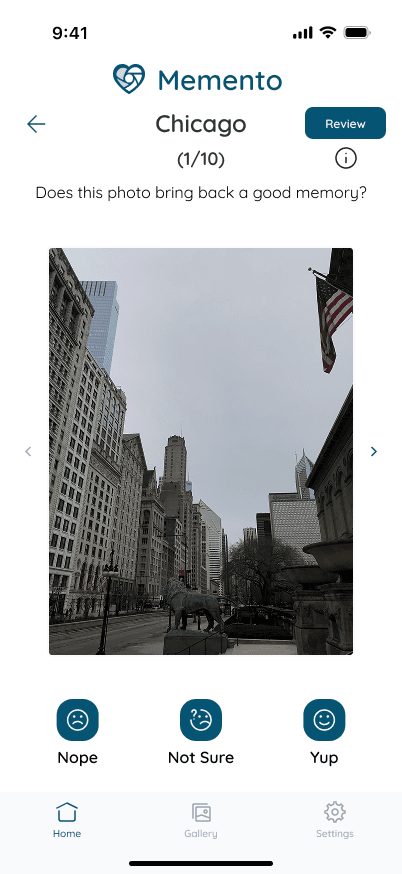
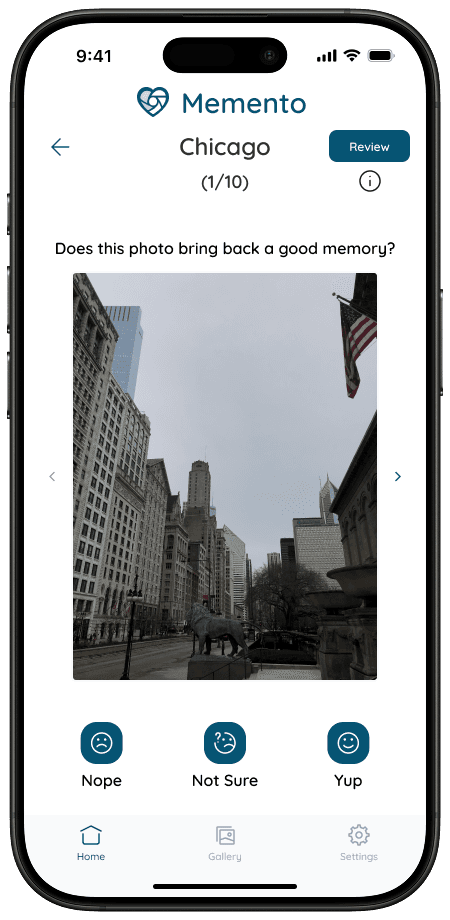
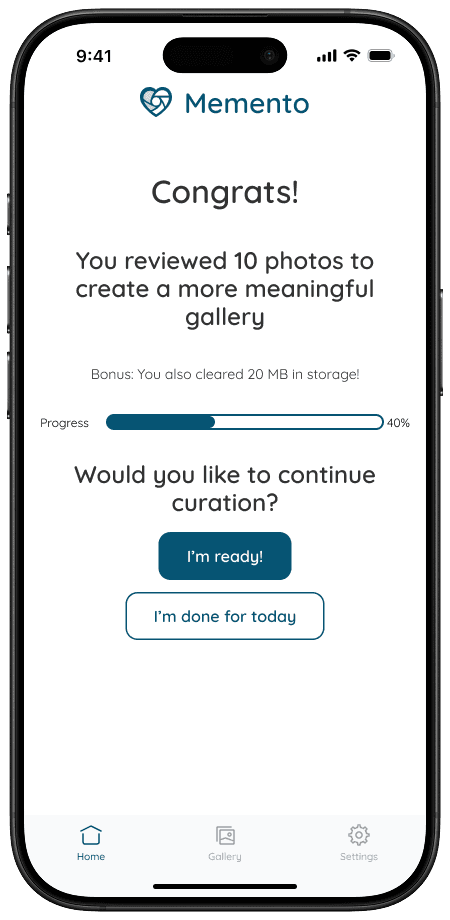
We introduced a batch selection model (e.g., "Review 10 photos") to provide a clear "Finish Line".
The Result
Users reported a higher sense of productivity and satisfaction upon completing a small, manageable task.
Decision 2: Reflective Prompts vs. Standard Voting
The Failure
Simple "Yes/No" buttons felt like admin work.
The Pivot
We reframed labels into Reflective Prompts (e.g., "Does this photo bring back a good memory?") paired with emotional responses ("Yup," "Not Sure," "Nope").
The Result
Testing confirmed these prompts acted as "emotional anchors," grounding users in their memories rather than their storage limits.
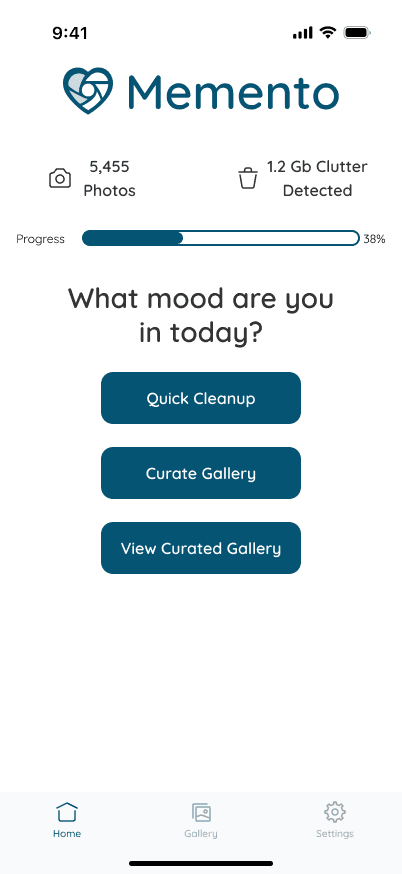
Decision 3: Simplifying Navigation for "Mood-Based" Actions
The Failure
Early home screens confused users with overlapping curation modes like "Start Curation" and "Quick Recap".
The Pivot
We consolidated the UI into three clear, action-oriented paths: Quick Cleanup (for noise), Curate Gallery (for memories), and View Curated Gallery (for reflection).
The Result
Navigation errors decreased as users could immediately align their intent with the available tools.
The final solution is a high-fidelity prototype that utilizes transparent AI to assist, rather than dictate, the curation process.
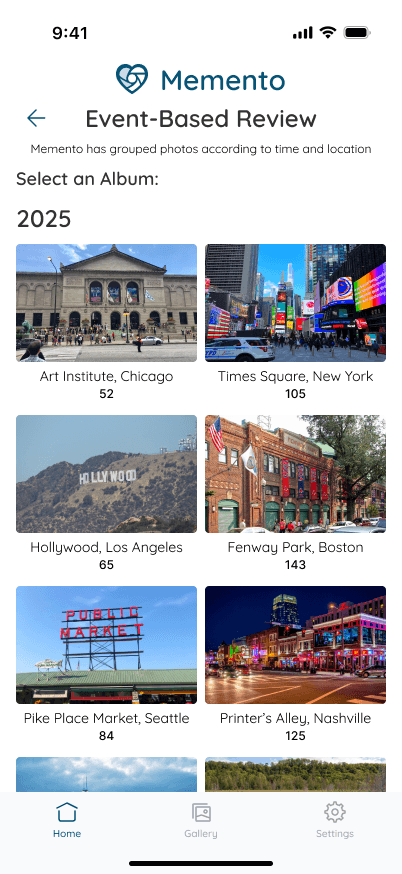
Intelligent Grouping
The system automatically clusters images by event, location, and people, mirroring how users naturally recall memories.
Content-Aware Prompting
Contextual questions surface at key moments to help users differentiate between "good photos" and "meaningful memories".
Gamified Satisfaction
Every session ends with a "Congrats" screen showing tangible progress: photos reviewed and storage freed.
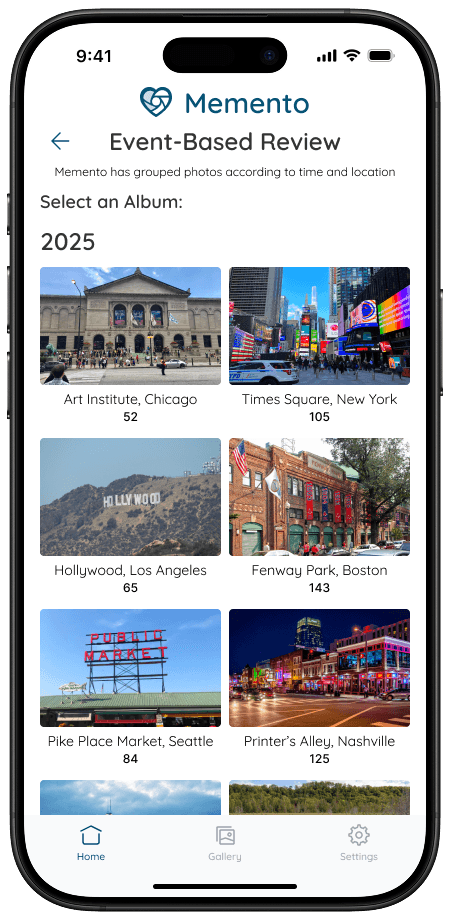
Memento shifted user perception of photo management from "exhausting admin work" to a "rewarding reflective practice".
Intuitiveness Score
Users rated the event-based organization as highly intuitive once the core flow was understood.
Behavioral Shift
Testing validated that small decision batches successfully reduced the perceived burden of curation.
Metrics of Success
In high-fidelity testing, users successfully identified and moved meaningful photos to albums while clearing significant "noise" (e.g., 20 MB in one 10-photo trial)
Conclusion
By treating photos as portals to sensory memories rather than pixels, Memento provides a viable framework for long-term digital memory preservation.